Eight centuries of the bookmark
A rotating parchment marker could remember one place. Eight centuries later the same word names a list that never forgets.
A rotating parchment marker could remember one place. Eight centuries later the same word names a list that never forgets.
For centuries, a rotating parchment marker kept a single passage rather than a list. A 1473 volume still carries that bargain. Vannevar Bush, in July 1945, proposed a trail through a store that a person could finish and pass on. The object that cannot accumulate is the subject here. The arithmetic of the free tap belongs to Why you never read what you save.
The original bookmark could remember one place
At the University Library in Leiden, a medieval parchment bookmark survives with a small rotating disc numbered one to four. The cord marked the opening, a sliding piece marked the line, and the disc marked the column. That was it. It could remember one place. Move it, and the old place is gone. In 2014 the book historian Erik Kwakkel identified the disc among manuscript scraps the library had filed as fragments.
Complete examples were around ten inches long, with a disc about an inch and a half wide. The design was simple, but useful: close the book, and you could return to exactly where you stopped.
A later survivor shows that print did not disturb the assignment. Franciscus Renner printed the sermons of Leonardus de Utino at Venice in 1473, and a copy still carries a registrum stitched into the volume it served. The book is printed rather than handwritten, and its marker is almost two hundred years younger than the Leiden example, yet cord, slider, and column marker still answer the same request. The carrier changed. Capacity did not.
A printed book keeps the old bargain
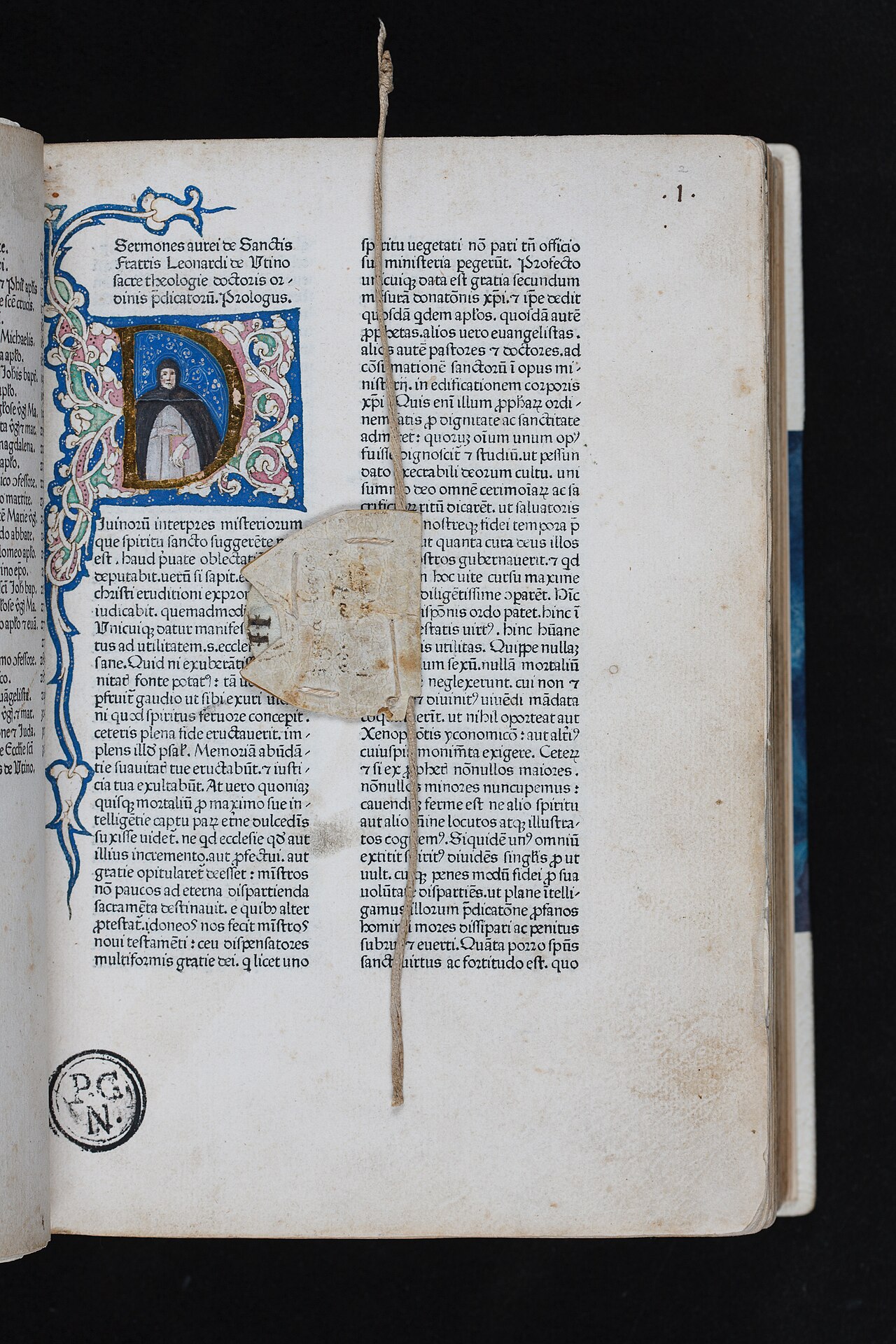
Figure 1. Print increased the supply of pages without changing the marker's capacity. In this 1473 volume, one cord, one slider, and one column marker still preserve only the reader's current place. Princeton University Library (Notabilia) published the photograph. Wikimedia Commons hosts it as public domain.
The photograph of Leonardus de Utino's Sermones aurei de sanctis makes the mechanism easier to inspect than Leiden's detached disc. The cord begins at the top of the spine and falls the full height of the open leaf. The parchment marker rests directly over a column of dense type. It does not summarize the sermon, rank it, copy it, or promise that the reader will return on a particular day. It holds a coordinate while the book is shut. That is all.
Figure 2. Around 1300 a reader could mark exactly one place. The cord fixed the opening, the slider fixed the line, and the disc, turned to one of four numbers, fixed the column. Every part of the mechanism is about getting back to a position. Nothing in it can hold two. Schematic, after the roughly three dozen registra recorded in European libraries. Surviving examples run to about ten inches of cord and a disc an inch and a half across.
The schematic strips away leather, illumination, and age. What remains is a storage device with one writable position. The user changes that position by moving matter, and the prior value disappears because there is nowhere else for it to remain. In present terms, the registrum performs a destructive update. That technical phrase sounds severe, but the effect is merciful: the object cannot accumulate deferred claims on its owner. It remembers where reading stopped, not everything reading might someday begin.
The Magdalen occupies the whole interval
Rogier van der Weyden (around 1399-1464) painted The Magdalen Reading around 1435. The panel is a fragment of a larger altarpiece, now at the National Gallery in London. A woman in a green gown sits on the floor of a timber room. An open book has both of her hands.
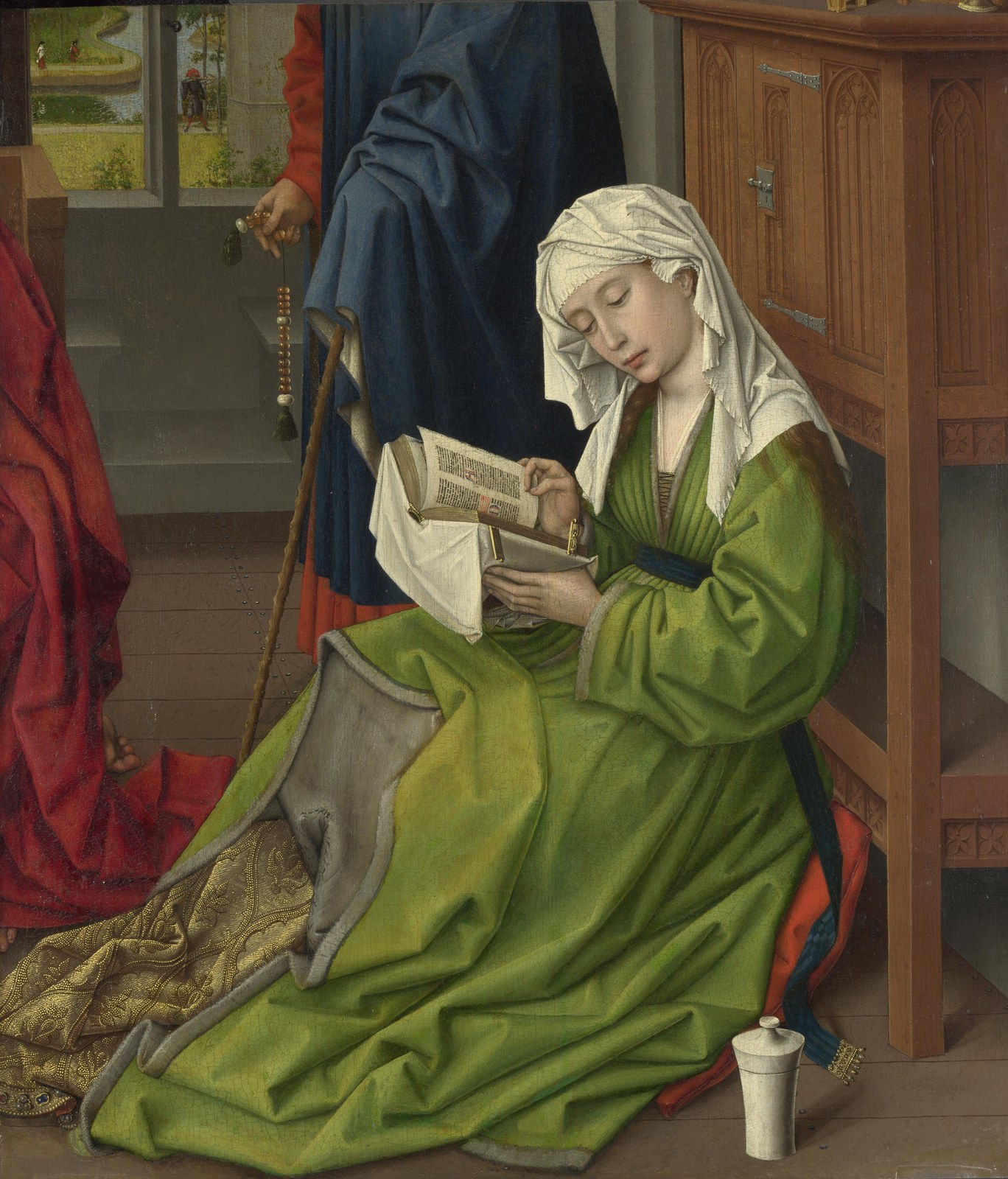
Figure 3. Van der Weyden records the attention that a capacity-one marker served. Around 1435, one book holds both hands while the window, the beads, and the jar wait without forming a queue. Rogier van der Weyden, The Magdalen Reading, around 1435. Oak, oil, transferred to mahogany. National Gallery, London. Wikimedia Commons hosts a public-domain photograph.
Look before interpreting. Her eyes are lowered to the page. Both palms support the volume. The ointment jar that identifies her as Mary Magdalene stands on the boards beside her skirt and casts a hard shadow. It is not being used. Behind her, a man later identified as Saint Joseph holds a staff and a string of amber beads. A landscape shows through the window. A red draped figure is cut off at the left edge, a remnant of the altarpiece this panel was sliced from. The room contains many objects. The interval contains one book.
The finding is monopoly. One volume owns one reader's attention until she lowers it. A registrum belongs to the same economy: it preserves the one place to which attention is supposed to return. Print had made books and loose markers cheaper by the 1800s, and readers could own several and lose many, but each marker still pointed into a volume already in hand. The object multiplied. Its unit of memory remained one.
That distinction is easy to miss because a paper marker and a browser button share a name. The older tool stores position inside an activity already underway. The newer tool stores entrance to an activity that may never start. One answers, Where did I stop? The other often answers, What did I once suspect I should read? Those questions produce different machines, even when the same word sits on both.
Bush imagined something different
In July 1945, before the modern web existed, Vannevar Bush proposed the memex in his essay As We May Think, published that July. His idea wasn't simply to store more information. It was to create a trail through information, a sequence of documents that a person could follow, finish, and even share with someone else.
That distinction matters. A bookmark saves an item. A trail saves the journey between items. Bush's idea was never fully built, but digital technology eventually gave us almost unlimited ways to save things. What it didn't give us was a good way to finish them.
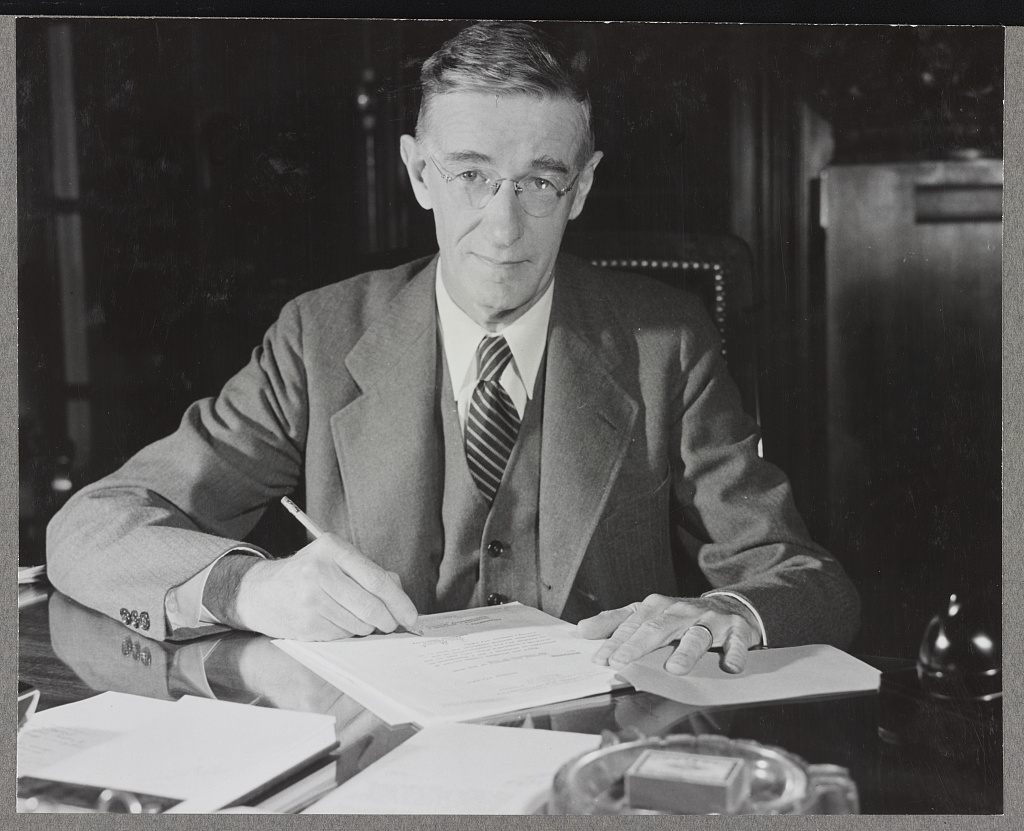
Figure 4. The desk holds the problem that Bush's memex was meant to solve. Papers can be stored in a stack, but the route through them vanishes unless association itself is recorded. Photograph for the Office for Emergency Management. Library of Congress Prints and Photographs, call number LC-DIG-ds-11801. Publication carries no known restrictions.
The camera shows Bush in a three-piece suit and round glasses at a polished desk. A pen is in his hand. Papers spread and overlap in front of him. The image, made for the Office for Emergency Management in the early 1940s and now held by the Library of Congress as LC-DIG-ds-11801, contains no speculative machinery. It contains the ordinary failure that made the machinery worth proposing: a desk can keep every page and still lose the sequence that made the pages useful.
Bush called his proposed furniture the memex. A person's books, records, letters, and files would be stored on microfilm inside a desk-like cabinet. Two screens would display material, a keyboard and controls would summon it, and retrieval would take seconds. Those parts answer the storage question. They are also the parts later illustrations and histories found easiest to repeat. Bush placed the harder mechanism in one sentence:
Selection by association, rather than indexing, may yet be mechanized.Vannevar Bush, writing in As We May Think, July 1945
Indexing begins with a location assigned in advance. Association begins with the item in front of the reader. While following a question, the reader joins that item to the next item, then joins the next to another, and the sequence of joins becomes a named trail. The trail can be stored, extended years later, copied for a colleague, and walked again in order. Bush's example follows a scholar investigating why Turkish short bows performed better than English long bows. By evening, the scholar has not merely collected documents. He has preserved the route by which one document made the next relevant.
A position remembers where reading paused. A trail remembers how inquiry moved.
The trail is the missing exit because it changes what completion means. A folder is complete only by an arbitrary rule, such as no more additions. A pile merely grows or shrinks. A trail, however, has an ordered last step, and a person can reach it without consuming every item in the cabinet. Bush did not propose less storage. He proposed a way through abundant storage that could end. Across the eighty years that followed, none of the shipped systems in this chronology inherited that property.
On September 10, 1945, Crimi draws the cabinet but not the route
The Atlantic printing carried no illustrations. On September 10, 1945, LIFE published a condensed and illustrated version, and Alfred D. Crimi, a draftsman whose earlier work included machinery drawings at Sperry, received the task of making Bush's prose visible. The familiar memex is largely Crimi's: a wooden desk with two slanted glass screens in its top, a keyboard, and a row of levers. Elsewhere in the spread, a forehead-mounted Cyclops Camera captures whatever enters its wearer's sight.
Wood, glass, keys, levers, and camera can all be outlined. Association cannot. A trail is a relationship among records encountered over time, so no single view of the cabinet can show the act that distinguishes it from a very efficient file store. Crimi's plates became the popular image of the memex, and histories of computing have repeatedly reproduced them, but the visible furniture encouraged later readers to remember rapid retrieval and forget ordered completion. The cabinet survived. The exit did not.
The later names, Mosaic, Netscape, Pocket, the private tap, belong to the guides that answer those products. This essay stays with the object that could not accumulate, and with the trail Bush named and Crimi could not draw.
Brant's fool keeps books he does not read
In 1494 Sebastian Brant (1457-1521) published Das Narrenschiff in Basel. The first fool in the book sits at the front of the ship because he owns books he does not understand. The woodcut is captioned Von unnützen Büchern: of useless books. The job on display is keeping, not finishing.
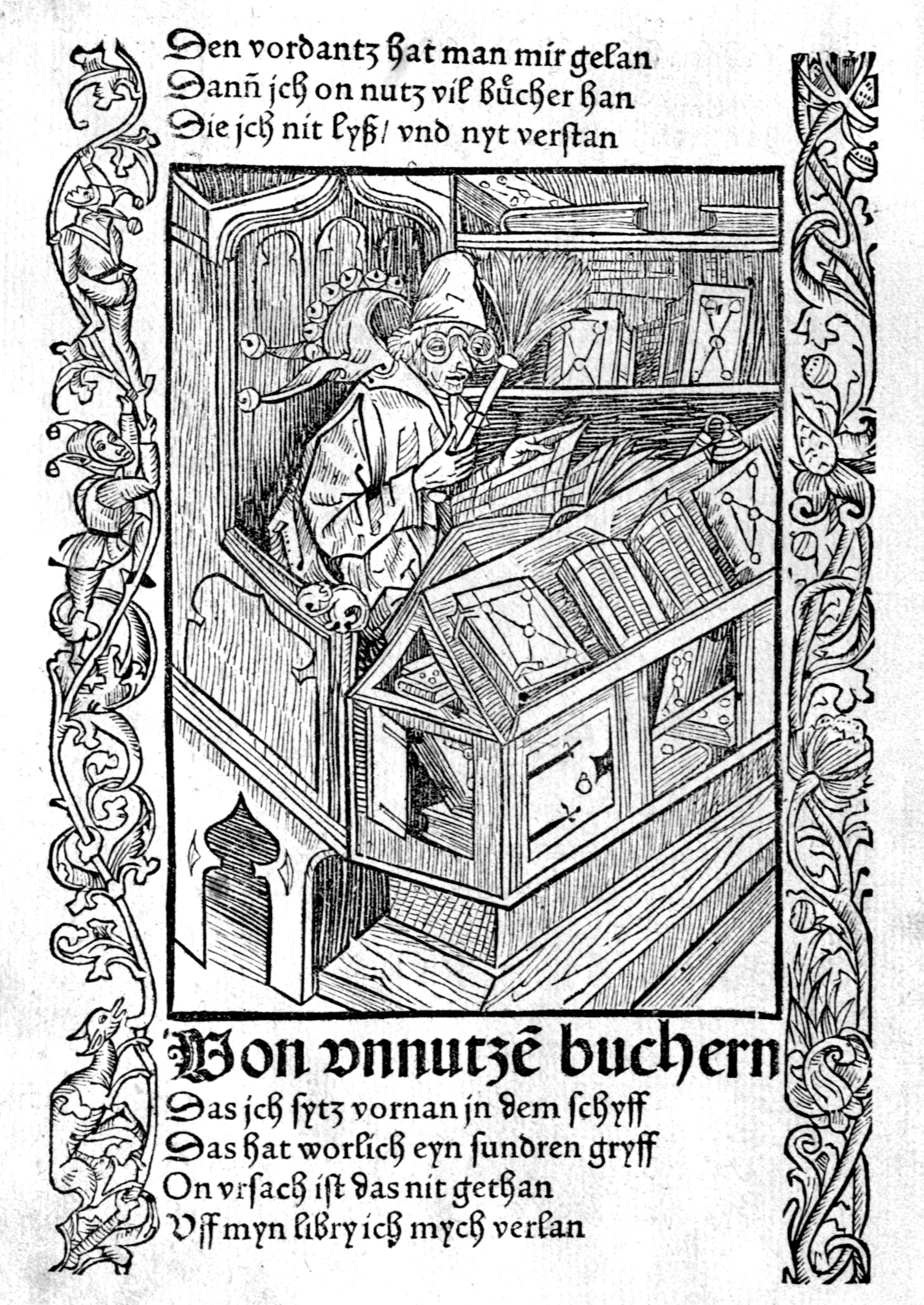
Figure 5. Brant gives accumulation its first printed fool. In 1494 the collector dusts a library he does not read, and the lectern is already full. Woodcut for Sebastian Brant, Das Narrenschiff, Basel, 1494, chapter Von unnützen Büchern. Often attributed to the young Albrecht Dürer. Wikimedia Commons hosts a public-domain scan.
Read the cut before asking it to explain anything. The fool wears glasses and a belled cap. A duster is in his right hand. The lectern in front of him is packed with closed volumes, clasps outward. More books wait on the shelf behind. He is not on a page. He is keeping flies off a store. The German lines over the frame say as much: he has many books, he does not read them, and he does not understand them.
The local joke does not exhaust the plate. Brant puts this fool first because the collection has already replaced the act. One paper marker occupies a column. A lectern of unread books occupies a life. The marker has multiplied until no hand remains on an open leaf.
Our bookmarks, saved posts, read-later lists and screenshots can become their own kind of library. We keep collecting things because saving them feels useful, even when we never return to them.
The medieval bookmark had a limit built into it. It could hold one place. The modern bookmark has almost no limit. And somewhere between those two designs, we stopped asking the most important question: Where did I stop?
The Magdalen still occupies one book. Brant's fool already dusts a library he does not read. Leiden's disc still points to one column. Bush's trail later named the missing exit when storage became abundant: preserve not only the item, but the path that lets inquiry reach a last step. The arithmetic of a one-second tap against a ten-minute read is a different essay. This one stays with the object that could not accumulate.
Back in the manuscript room at Leiden, only the numbered disc survives. A separate complete example supplies the ten-inch strip and inch-and-a-half wheel that reconstruct the mechanism. Their smallness is not a primitive version of a deficient list. It is a complete answer to a different question. The registrum asks where reading will resume, permits one answer, and makes the previous answer depart.
Sources
- Leiden University Library's 2014 report, Rare medieval bookmark found in Leiden University Library, records the incomplete disc as BPL 3327 and describes about thirty-five known rotating markers worldwide. The separately preserved Rota versatilis marker reported after a 2026 Dorset auction measured ten inches, with an inch-and-a-half disc carrying the numerals one to four.
- Vannevar Bush published As We May Think in the Atlantic Monthly in July 1945. On September 10, 1945, LIFE ran a condensed illustrated version (volume 19, number 11). Alfred D. Crimi made the drawings. Mosaic, Netscape, Pocket, and the private tap belong to the how-tos that answer those products, not to this cut.
- Plates named in the text. Rogier van der Weyden painted The Magdalen Reading around 1435 (oak, oil, transferred to mahogany, National Gallery, London). Sebastian Brant's Das Narrenschiff appeared at Basel in 1494. The woodcut for the chapter Von unnützen Büchern is often attributed to the young Albrecht Dürer. Both sit in the public domain. Photographs come by way of Wikimedia Commons.
- The registrum photograph is Leonardus de Utino's Sermones aurei de sanctis, issued at Venice in 1473 by Franciscus Renner. Princeton University Library published it through Notabilia. Public domain, via Wikimedia Commons. Library of Congress holds the Bush portrait as LC-DIG-ds-11801, an Office for Emergency Management photograph made between 1940 and 1944, issued with no known restrictions. Alfred D. Crimi's LIFE plates of the memex are still under copyright, so this essay shows a schematic instead of his original drawing.