The Unread Letter
You would have paid before you knew what was inside. A letter used to stop a room. Then arrival learned to finish without a reader.
You would have paid before you knew what was inside.
A carrier waited at the door with a folded sheet. The coin came out of your pocket, or the letter went back down the road. Most of what reaches you now would never have survived that test. It arrives because arrival got cheap, and cheap arrival does not ask whether anyone is free to read.
A letter used to be an event in a room. Then it became stock on a board. Then unfinished stock acquired residents, the way a tower acquires washing in galleries that have not reached their crown. Those are not three moods of the same pile. They are three prices, and only the cheapest one is still in force.
Four paintings and a postal rule. Then one sitting with two prices: open the sheet, or refuse it. There is no honest third.
The X-ray found a person, not a sketch
In 1979 an X-ray passed through a canvas painted around 1657 and found a second picture inside it. Not a sketch at the edge. A standing Cupid, nearly as tall as the young woman who reads at the open window, holding a bow while one foot presses a mask to the floor.
Johannes Vermeer (1632-1675) painted Girl Reading a Letter at an Open Window in Delft around 1657. The Gemäldegalerie Alte Meister in Dresden has it. For more than two centuries visitors saw pale plaster behind her and took that vacancy as Vermeer's decision. Conservators first thought Vermeer had covered Cupid himself. A campaign begun in 2017 showed the overpaint had been applied decades after he died. They removed it centimetre by centimetre. In 2021 the museum presented the canvas with Cupid visible again.
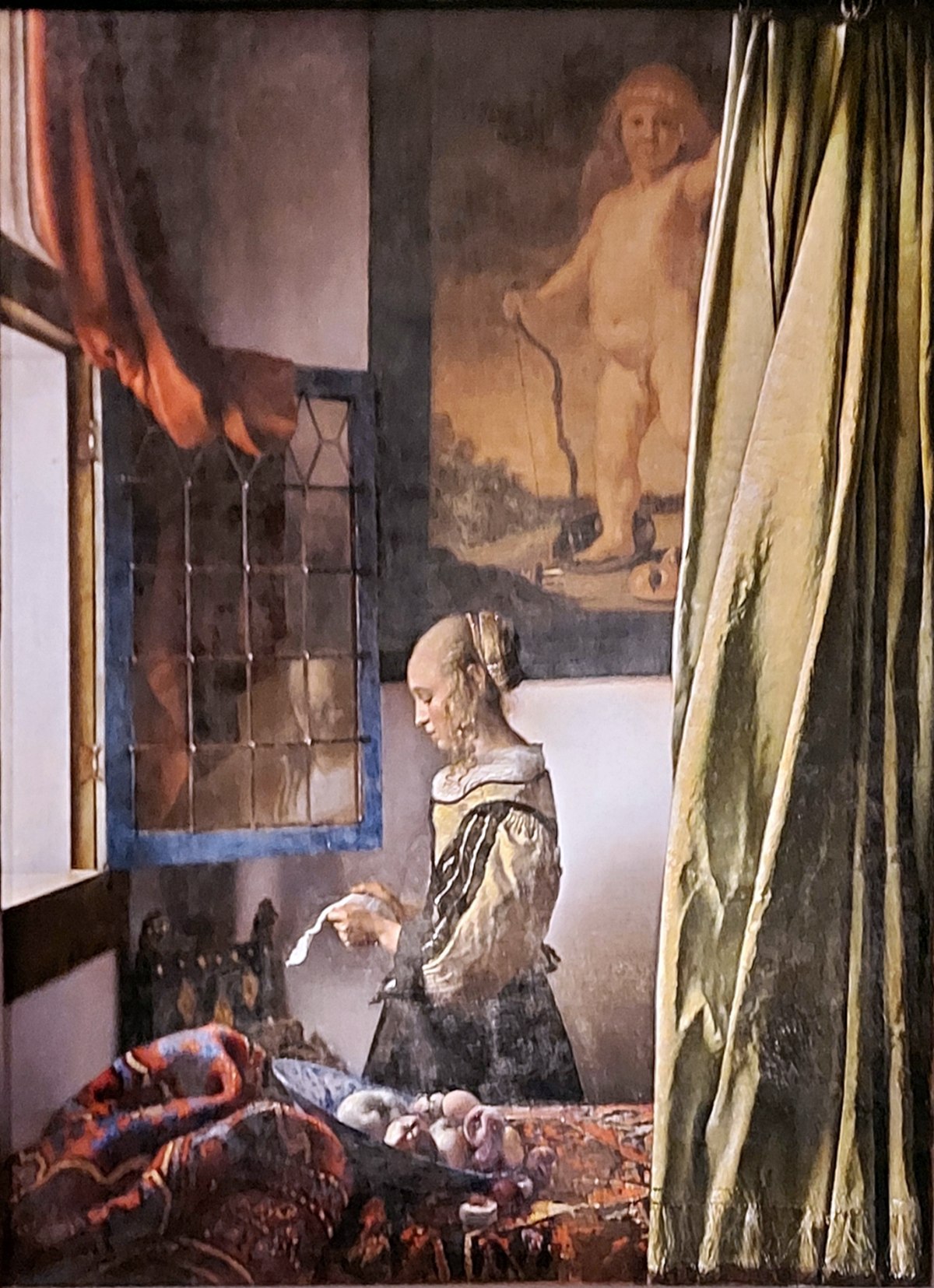
Figure 1. Around 1657, one sheet has the whole of her. Fruit, carpet, window, even Cupid can wait. Johannes Vermeer, Girl Reading a Letter at an Open Window, about 1657 to 1659, in its restored state. Oil on canvas. Gemäldegalerie Alte Meister, Dresden. Public domain, via Wikimedia Commons.
Read the room from the light inward. The casement is open because the page requires day. In one pane her profile duplicates itself, a second reader made of glass. Her hands meet at the sheet. On the table a bowl has tipped and fruit has rolled. A green curtain is drawn back like a stage. Cupid repeats that disclosure on the wall. Bow, mask, letter: the room can say what she does not.
None of the bright objects can recover her gaze. The fruit will not be gathered. The street beyond the window will not be looked at. A person elsewhere has arrived in folded paper, and for the time needed to reach the last line that absent person possesses the standing reader.
Scarcity made that possession plausible. The sheet had taken material, labor, carriage, and waiting. It was not one item among forty. It was the event. Cupid's foot on the mask is the same claim from the wall: the letter is allowed to unmask her. A badge is not. A badge is the mask still on, plus a number.
A notification has almost never possessed you like that. Not because your taste collapsed. Because almost nothing that reaches you has paid the fare that would let it stop a room.
Then the needle went down
About seven years later the interruption became a household, not a solitude.
Gabriel Metsu (1629-1667), born in Leiden and later active in Amsterdam, painted a pair around 1664 to 1666: a man writes beside a window, a woman reads what has arrived. The National Gallery of Ireland hangs both panels in Dublin. The receiving panel is the one that should make you uncomfortable.
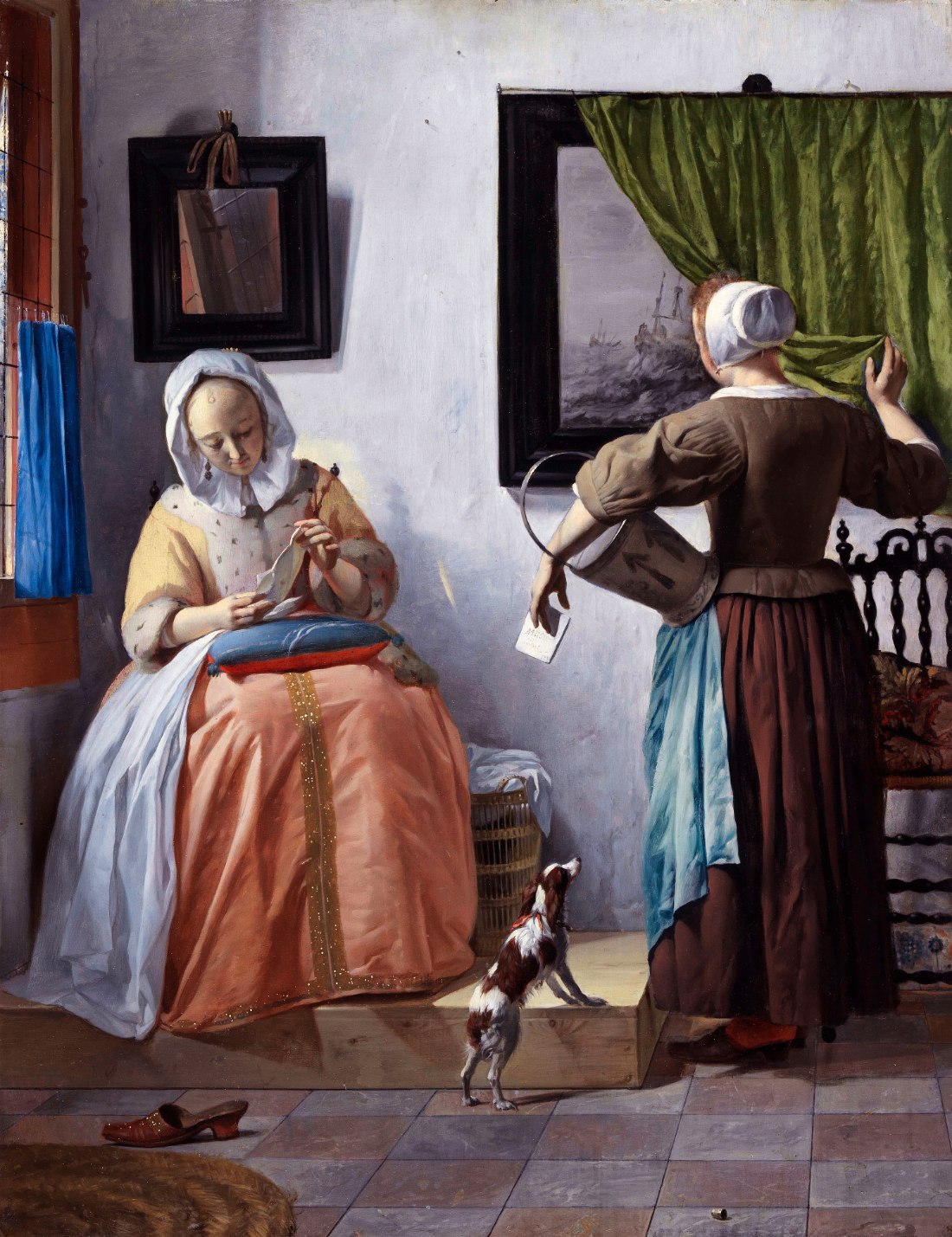
Figure 2. Around 1665 the needle is down, the maid still holds the cover, the dog has looked up. One delivered sheet changed every active body in the room. Gabriel Metsu, Woman Reading a Letter, about 1664 to 1666. Oil on panel. National Gallery of Ireland, Dublin. Public domain, via Wikimedia Commons.
Begin with the cushion. Sewing lies where she set it down, close enough to prove the letter did not fill an idle hour. It cut one. She holds the page nearer her face. One shoe is off on the tiles. The small dog has raised its head. Behind the chair a maid still holds the wrapper and a bucket, and with her other hand she lifts a green curtain from a seascape. The ship in that inner painting heels through rough water. A domestic room has acquired wind.
Before the letter: needlework, a covered picture, an inattentive dog, a servant in motion. After the letter: a reader, stopped sewing, a delayed maid, a revealed ship, an animal watching the change. The message did not win a private argument inside one skull. It reorganized labor across the room.
Your lock screen adds a badge and calls that correspondence. The household does not stop. The dog does not look up. A badge is how a claim arrives without becoming an event.
The addressee paid first
Those rooms make more sense once you rebuild the door.
A seventeenth-century letter began with handmade paper, ink, and the writer's time. It then needed a carrier on roads for days or weeks. In much of Europe postage commonly fell to the addressee rather than the sender. The person at the door could pay and take the folded sheet, or refuse it and have it returned. Rebekah Ahrendt and David van der Linden's work on the Brienne archive is blunt about this: refused letters were a real outcome, not a metaphor. A writer spent without a guarantee. A reader spent without a preview. Both sides met a price before the wax broke.
Expensive mail could still be stupid. The frictions did not purchase wisdom. They made indiscriminate sending costly. Every extra letter consumed another sheet, another act of writing, another trip, another chance of a slammed door. There was no nearly free duplication. There was no stream that continued because yesterday's pages were still sealed.
A delivered letter had survived the writer's expense and your decision to take it. Breaking the seal acknowledged a claim between named people. You knew who had undertaken the sending. You held the folds, the address, the wax. Context was attached to the object. You did not have to invent a reason from a thumbnail.
A dear message arrives with its reason attached. Cheap traffic arrives asking you to invent a reason for each item.
The difference is not nostalgia for paper. It is a change in who bears the work. Under recipient-paid post, writer and reader each faced a price before correspondence entered the room. As production got cheaper, more material could arrive without a matching increase in hours to read it. Selection moved downstream. You inherited not only messages, but the labor of deciding which ones deserved a broken seal.
That labor is the unread pile. It is not a character flaw. It is a bill that used to be collected at the door and is now collected, endlessly, behind your eyes.
By 1699 they only needed nails
Edward Collier (around 1642-1708) worked in Leiden and London and signed his first name as Edwaert or Edward according to the market. Through the 1690s he returned to a board crossed by ribbons. In a work dated 1699, three red leather straps hold paper and tools against a dark ground.
Vermeer needed a standing woman to show what a letter did. Collier needed nails.
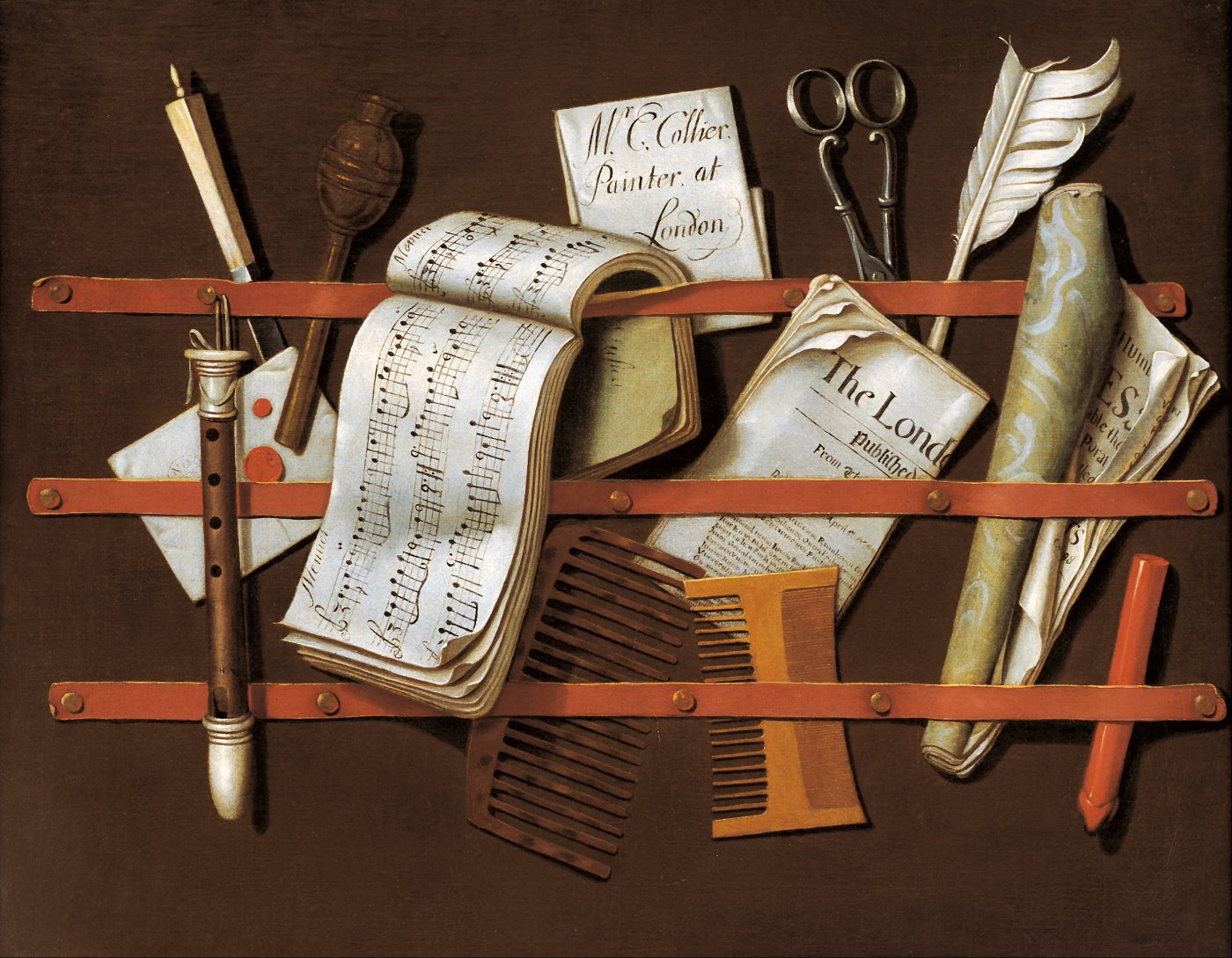
Figure 3. In 1699 the reader has vanished. Red straps hold a sealed letter, folded news, shut music, and a rolled pamphlet beside the tools of a reply that never starts. Edward Collier, trompe-l'oeil letter rack, about 1699. Oil on canvas, Google Art Project scan. Public domain, via Wikimedia Commons.
Read the board item by item. The letter is folded and closed with two spots of red wax. Its address names Mr E. Collier, Painter, London, so the painter has made himself the recipient of the most conspicuous demand. A newspaper remains folded to its London masthead. Sheet music, marked Menuet, sits in a thick unopened fold. A pamphlet is rolled inside marbled paper. Two combs, a recorder, scissors, a quill, and a stick of sealing wax fill the gaps. The tools to groom, play, cut, write, and answer are present. Action is not.
Dror Wahrman tracked down seventy variations of this fixture, often with Collier's own name on the letters. Repetition makes the unbroken wax more than a local joke. News has arrived and stayed folded. Music is available and stayed shut. The quill that could answer lies under the same straps as the unanswered letter. The trompe-l'oeil promises objects a hand might reach. The actual hand is absent. The board is busy with invitations and empty of a person.
Metsu's wrapper is still in the maid's hand because the recipient has already opened the sheet. Collier's letter has been secured for later because no recipient appears. In roughly thirty-four years the household interrupted by one page gives way to a fixture managing several untouched arrivals. The reader did not become distracted inside the picture. The reader was removed from it.
That is the invention worth naming. Not more paper. A surface that lets delivery complete while reading does not. Once that surface exists, receipt no longer implies a reader, and the count of retained items can rise on its own. Weak will is optional. An input rate that can exceed the reading rate, plus a board that preserves the difference, is enough.
Receipt is not reading.
Washing already hangs in the unfinished galleries
Here is the part the letter rack shares with a tower, and does not share with a bookmark.
Pieter Bruegel the Elder (around 1525-1569) painted the Vienna Tower of Babel in 1563. The Kunsthistorisches Museum has it. Washing hangs in the lower galleries of a tower that has not reached its crown. People have moved into the lower floors while masons are still raising the upper ones. The building is occupied before it is complete.
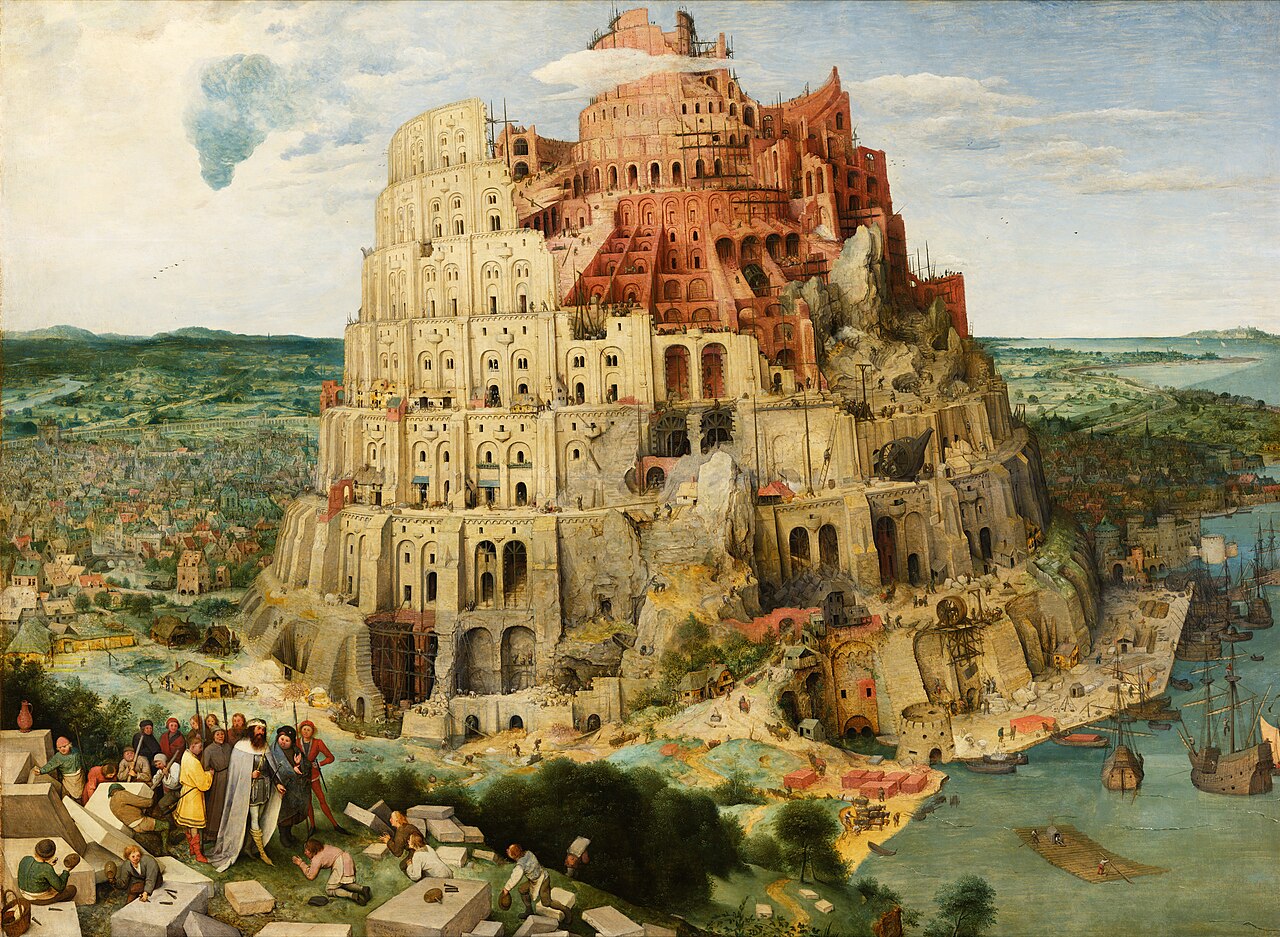
Figure 4. In 1563 the lower galleries are already inhabited while the crown remains raw. Unfinished work has acquired residents. Pieter Bruegel the Elder, The Tower of Babel, 1563. Oil on panel. Kunsthistorisches Museum, Vienna. Public domain, via Wikimedia Commons.
Before occupancy, a bad passage can be torn out. After occupancy, the same correction interrupts rooms, traffic, and livelihoods. Every finished floor creates a constituency for keeping that floor open, even when closing it would make the next floor possible. Nimrod can command another course of stone. He cannot make the washing leave.
Collier's straps are occupancy at household scale. Each sealed letter is a resident. Each folded newspaper is a resident. You cannot rebuild the system while the claims are living in the lower galleries of your week. The rack is not waiting to be processed. It is already being lived in, which is why every new tool for processing it feels like adding a storey to a tower people already sleep in.
A board full of sealed paper is easy to defend. Emptying it would mean you were never the person who had so much coming in. So the next free claim moves into a room that was already spoken for, and the washing stays.
Vermeer's fruit is still on the carpet. Collier's wax is still unbroken. Bruegel's washing is still in the gallery. None of those objects will file themselves.
Two prices, the way the door used to work
The useful nights of actually reading start after a board has sat there with nobody in it long enough to become insulting.
You do not need a new fixture. You need the old door, for an hour, on claims you already accepted. One named sheet. The rest out of reach. Not sorted into a prettier rack. Outside.
Open it now, or refuse it. Those are the two prices the old door offered. "For later" is how Collier kept a painter in the address and a person out of the room. A summary of the sheet is not the sheet. If you are still holding it when the hour ends, you refused the sitting, not the letter. Put the rest of the board in another room if you have to. Out of sight is the only version of "outside" that still works.
While it is open, the household stops the way Metsu's needle went down. Phone face down. No new covers arriving in the maid's other hand. When the letter is done you are still there. You answer, or you end it. You do not nail it back under the strap and go hunting for a more impressive board.
At the end of the hour, how many seals still unbroken. Write the number. Not a vibe. A number.
A letter, for most of the years that word meant anything, was not a badge. It was a claim that had already paid to stop a room.
Vermeer's sheet still has both of her hands. Metsu's needle is still down. Collier's wax can still be broken. The washing can still come out of the gallery, though not all at once, and not while you keep handing the lower floors to new tenants.
The next free claim will try to move in before this one is done. Let it wait at the door.
Is the seal broken?
Sources
- Johannes Vermeer, Girl Reading a Letter at an Open Window, around 1657 to 1659, oil on canvas, Gemäldegalerie Alte Meister, Dresden. An X-ray in 1979 found Cupid beneath later plaster. Conservation begun in 2017 removed that covering, and the restored painting was presented in 2021.
- Gabriel Metsu, Man Writing a Letter and Woman Reading a Letter, around 1664 to 1666, oil on panel, National Gallery of Ireland, Dublin.
- Dror Wahrman's Mr. Collier's Letter Racks identifies seventy surviving examples. The 1699 board reproduced here is the Google Art Project scan listed by Wikimedia Commons.
- Rebekah Ahrendt and David van der Linden, The Postmasters' Piggy Bank, documents recipient-paid postage and refused letters in the seventeenth-century Brienne archive.
- Pieter Bruegel the Elder, The Tower of Babel, 1563, oil on panel, Kunsthistorisches Museum, Vienna. Occupancy before completion is the insight carried into this sitting. The Rotterdam panel, Kircher's 1679 arithmetic, and the measured modern cases remain the subject of a later essay.